Diagnostic Ultrasound
RBC aggregation analysis for circulatory disease diagnosis
Overview
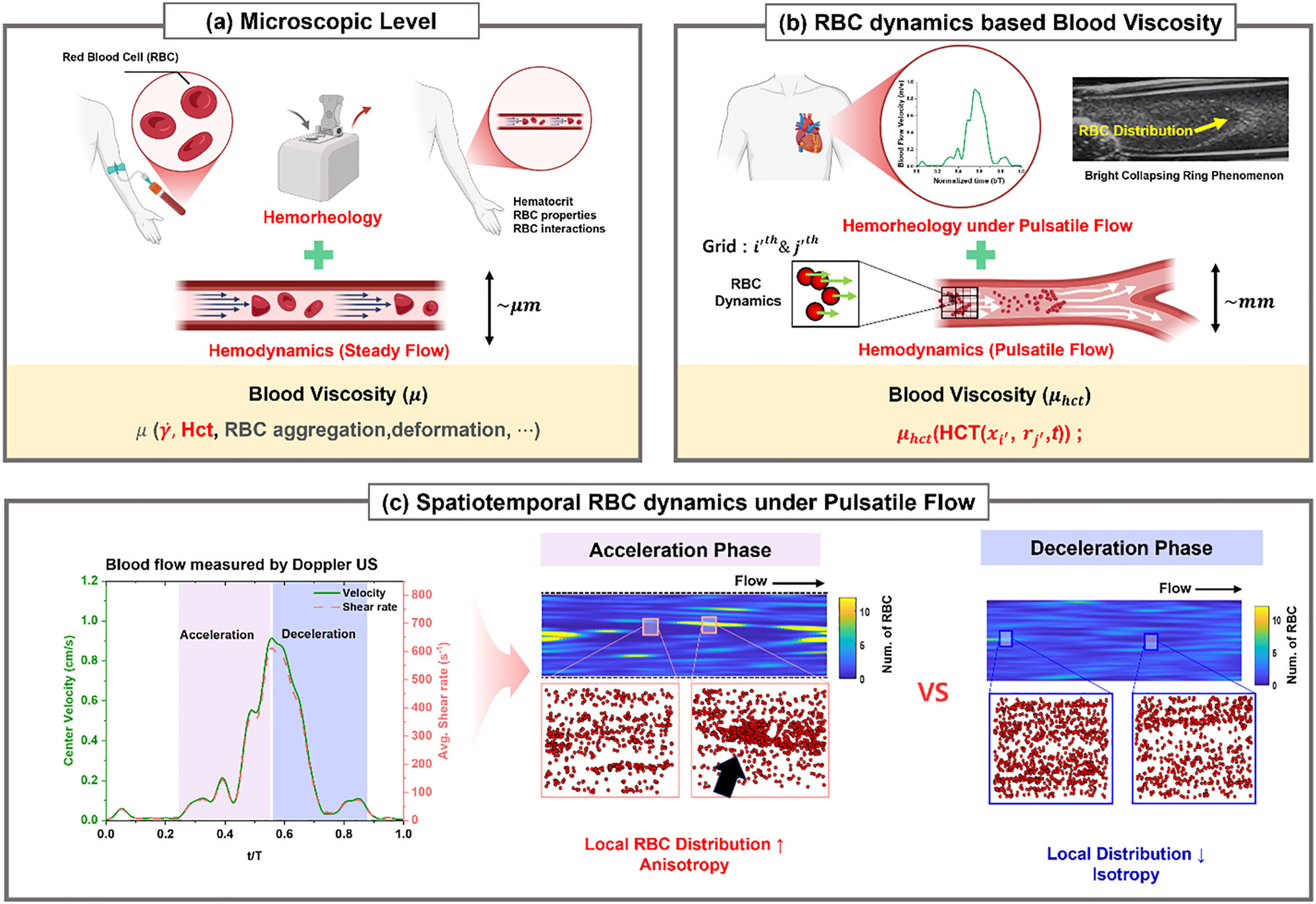
Our diagnostic ultrasound research links hemodynamics and hemorheology to understand how red blood cells (RBCs) behave in large arteries under pulsatile flow, supporting the diagnosis and prognosis of cardiovascular and circulatory diseases.
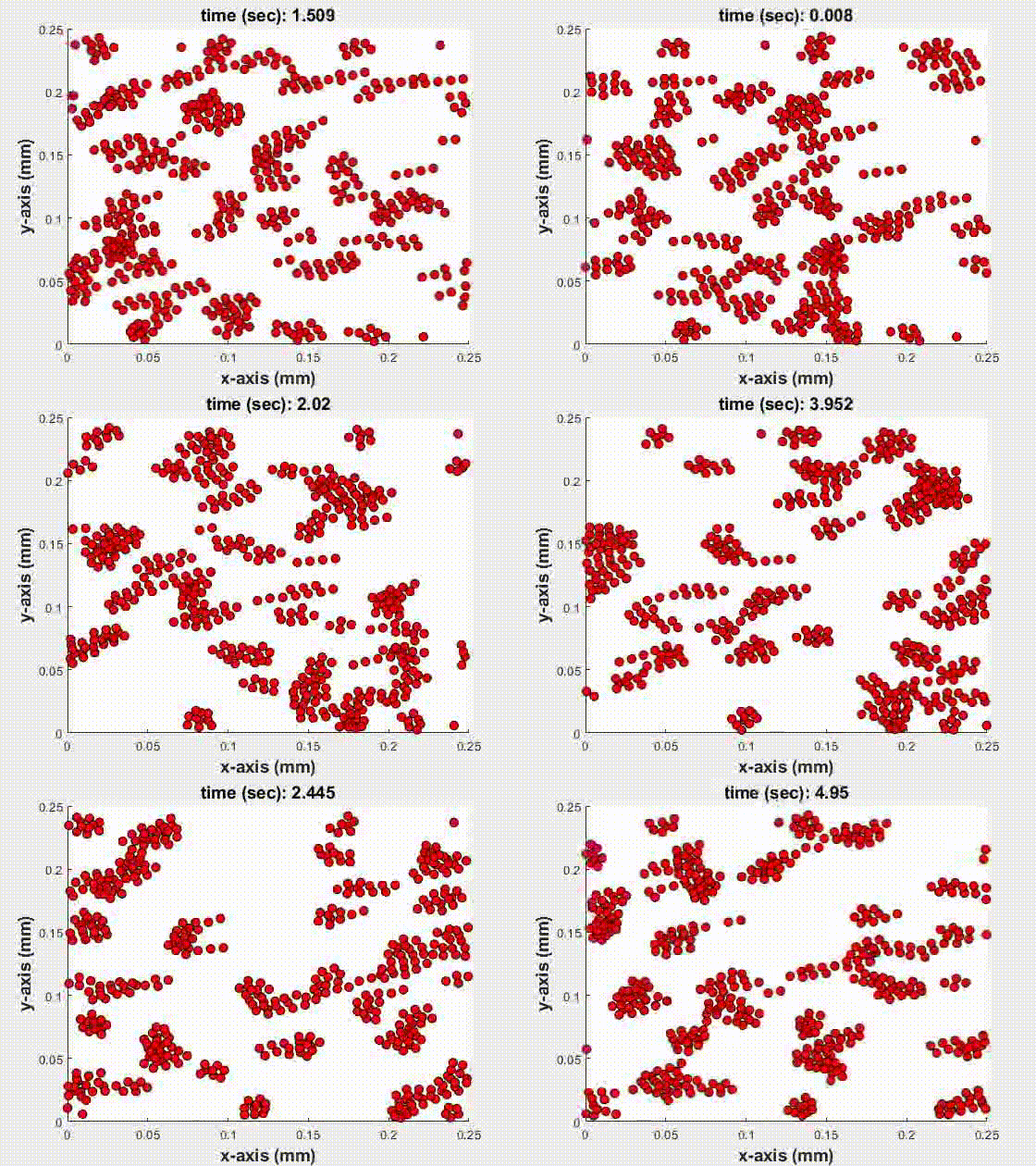
Using a particle-based numerical model, we showed that erythrocyte aggregation under Womersley flow in an elastic vessel depends mainly on the axial shear rate: local aggregates form parabolic or M-shapes within a specific axial shear-rate range, while mean aggregation decreases with the radial shear rate (Lee et al., 2023). Building on this, we developed a 2D computational model that couples RBC dynamics with blood viscosity under pulsatile flow and combined it with whole-blood experiments using ultrasound B-mode imaging. This demonstrated that spatiotemporal variations of local hematocrit drive local variations of blood viscosity, with viscosity increasing in regions of elevated hematocrit during the acceleration phase of the pulsatile cycle (Lee & Paeng†, 2025).
Research Fields
- Numerical simulation of erythrocyte (RBC) aggregation under pulsatile (Womersley) flow
- Axial shear rate as a hemorheological factor for local erythrocyte aggregation
- Spatiotemporal blood viscosity from local hematocrit under pulsatile flow
- Coupling whole-blood ultrasound B-mode imaging with computational hemodynamic modeling
References
2025
2023
- Axial shear rate: A hemorheological factor for erythrocyte aggregation under Womersley flow in an elastic vessel based on numerical simulationComputers in Biology and Medicine, 2023
